Key Takeaways
- Clarify whether your purchase is investment-led, lifestyle-led, or hybrid before booking any viewings.
- Budget an additional 7% to 10% for buying costs in most Alpine territories (France, Italy, Austria), though Switzerland remains lower at 3% to 5%.
- Winter trips verify ski access and crowd levels; spring and summer reveal structural damp and sun exposure problems that snow conceals.
- Walk from the property to the nearest lift in ski boots. Marketing claims of proximity rarely account for vertical terrain or gear.
- Use a forward contract to lock your exchange rate for up to 12 months. Currency shifts can wipe out your negotiating gains.
Define Your Buying Motive Before You Book
The first question is not "where" but "why". An investment-led buyer prioritises rental yield and resale. A lifestyle-led buyer prioritises personal use, specific terrain, and convenience. A hybrid sits somewhere between. Each motive changes the type of property, the resort shortlist, and the financial structure. Getting this wrong wastes viewing trips.
Involve every decision-maker early. The "perfect" alpine property is rare enough that it has its own industry term: "unicorns on ice". If one partner wants a Chamonix townhouse and the other wants a Val d'Isere apartment with rental income, that conflict needs resolving before anyone boards a plane.
Consider using a standard ski holiday as a "proto viewing trip". Spend the week thinking like a buyer rather than a tourist: observe how the resort handles peak-season crowds, test the lift infrastructure, and walk the village after 6pm. It costs nothing extra and filters out resorts that look good on paper but feel wrong on the ground. Some buyers find that so-called "backdoor resorts" like Les Menuires, which shares the 3 Valleys ski area, offer better value than the marquee names beside them. The new Pointe de la Masse gondola, one of the fastest in France, has transformed what was once the budget end of the valley into a high-speed hub. The Caron 3200 link between Orelle and Val Thorens is also worth noting as an insider day-trip option from the area.
Three Ways to Organise a Viewing Trip
How you structure the trip determines what you see and how much control you have. There are three models, each with trade-offs.
| Model | How It Works | Advantages | Limitations |
|---|---|---|---|
| Self-Organised | You contact multiple agents directly and manage your own schedule and transport. | Access to a broader range of properties across different agents. | Logistics in mountain terrain are time-consuming. Expect to manage competing appointment slots. |
| Agent-Led | A local agent curates an itinerary, arranges viewings, and provides introductions. Contact them several weeks in advance for a tailored schedule rather than seeing whatever happens to be available. | Efficient use of time. Local knowledge filters out unsuitable properties before you arrive. | Limited to one agent's stock and network unless you engage multiple agents separately. |
| Developer-Led | A developer subsidises a 2 to 3 night trip, typically costing £400 to £600, often refundable upon purchase. | Low upfront cost. Accommodation and transport often included. | You will only see that developer's own stock. No independent options. |
When to Go: The Seasonal Trade-Offs
There is no single "best" season for a viewing trip. Each window reveals things the others hide, and most buyers benefit from visiting at least twice in different conditions. On average, buyers make 1 to 2 trips before purchasing.
| Season | What You Can Verify | What You Will Miss |
|---|---|---|
| Winter (Peak) | Ski-in/ski-out claims, lift proximity under real conditions, how the resort handles peak crowds and snowfall. | Structural damp caused by snowmelt. Sun exposure problems concealed by snow cover. |
| Spring / Autumn | The town without the tourist facade. Agent availability is better. Travel is easier and cheaper. | No snow to test ski access. Resort atmosphere may feel very different to the winter experience. |
| Summer | Dual-seasonality potential (hiking, mountain biking). Sun exposure and orientation issues become visible. | No way to assess ski-season functionality. A property that feels bright in July may sit in mountain shadow from November to March. |
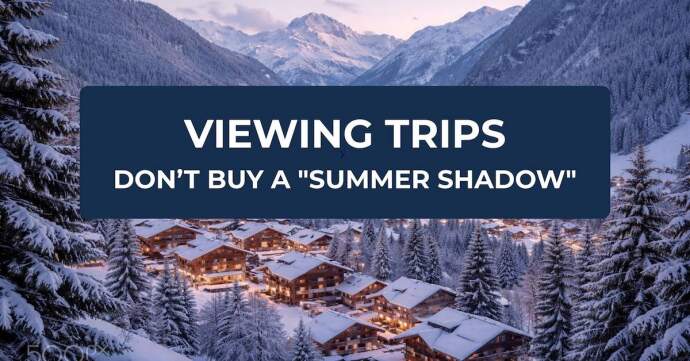
The Summer Shadow Problem
A property that looks perfect in summer may be entirely shrouded in shadow by a mountain during the winter months. This affects heating costs and whether the property feels liveable during ski season. If you visit only in summer, ask the agent specifically about winter sun exposure.
The Technical Inspection Checklist
Limit viewings to 3 to 4 properties per day. Mountainous terrain and travel time between sites make more than that counterproductive.
Put on ski boots and walk from the front door to the nearest lift. Marketing materials often claim a property is "100 metres" from the piste, but this rarely accounts for vertical terrain, steps, or the difficulty of walking in gear. The only reliable test is doing it yourself.
Inspect behind the fridge, around window frames, and at ground level for signs of penetrating or rising damp. These problems are more visible in spring when snowmelt exposes moisture ingress, but checking in any season is essential.
Run the tap furthest from the boiler and check the pressure. Ask about the boiler's age and warranty status.
Properties with wood construction may face specific lender restrictions. Confirm the build material early, as it can affect mortgage eligibility.
If rental yield matters, check for heated underground parking and a dedicated ski locker with boot warmers. For the high-end rental market, these are considered non-negotiable by guests.
Financial and Legal Mechanics
Currency volatility is one of the largest and least understood risks for international buyers. A shift of a few percentage points between offer and completion can add thousands to the final cost. Forward contracts allow you to lock in an exchange rate for up to 12 months, giving you budget certainty through the purchase process. Experienced buyers also use limit orders, which automatically execute a transfer when the market hits a target rate, allowing you to benefit from favourable movements without watching the market daily.
Buying costs (notary fees, registration taxes, and associated charges) typically add 7% to 10% to the purchase price in France, Italy, and Austria, though Switzerland remains lower at 3% to 5%. This is on top of the agreed price, not included within it.
France operates a specific tax regime for furnished rental properties known as LMNP (Loueur en Meublé Non Professionnel). Certain leaseback schemes in France also offer a 20% VAT refund on the purchase price. Both require specialist tax advice before committing. In some jurisdictions, viewing trip expenses (flights, accommodation, agent fees) may be treated as tax-deductible search costs, though this varies and should be confirmed with a local tax adviser.
Some countries require local tax identification numbers before you can proceed: Spain requires an NIE and Portugal requires a NIF. In France, the preliminary contract is the Compromis de Vente, while the final deed is the Acte Authentique. One practical comfort: gazumping is effectively prevented in France and Italy once a written offer has been formally accepted; at this point, the seller is legally committed to the buyer.
Unmarried couples buying together face different ownership structures and inheritance tax implications than married couples. This should be settled with a specialist lawyer before the viewing trip, not after.
Key Financial Figures
7% to 10%: typical buying costs in France, Italy, and Austria (3% to 5% in Switzerland). 20%: VAT refund available via certain French leaseback schemes. £400 to £600: typical cost of a developer-led 2 to 3 night viewing trip, often refundable upon purchase. 3 to 4: maximum recommended property viewings per day. 1 to 2: average number of trips buyers take before purchasing.
Frequently Asked Questions
How many properties should I view per day?
No more than 3 to 4. Mountainous terrain and travel time between sites make more than that counterproductive.
How many trips will I need before buying?
Most buyers complete their purchase after 1 to 2 viewing trips. Visiting in different seasons (one winter, one summer) gives you the most complete picture of the property and resort.
What is the Boot Walk?
A practical test where you walk from the property to the nearest lift in full ski gear. Marketing claims of "100 metres to the piste" rarely account for vertical terrain, stairs, or the reality of moving in boots. The Boot Walk is the only way to verify proximity claims.
Can I reclaim VAT on a French ski property?
Certain leaseback schemes in France offer a 20% VAT refund on the purchase price. The structure involves committing the property to a managed rental programme. Specialist tax and legal advice is required before entering any such arrangement.
Is gazumping a risk when buying in the Alps?
In France and Italy, gazumping is effectively prevented once a written offer has been formally accepted. At that point, the seller is legally committed to the buyer. This protection does not apply in all Alpine countries, so check the local rules for your target market.
Do unmarried couples need to do anything differently?
Yes. Unmarried couples face different ownership structures and inheritance tax rules than married couples. These issues should be resolved with a specialist property lawyer before the viewing trip, not after you have found a property you want to buy.
Plan Your Viewing Trip
Talk to our team about resort shortlists, agent introductions, and the financial groundwork you need in place before you travel.
Get in Touch